

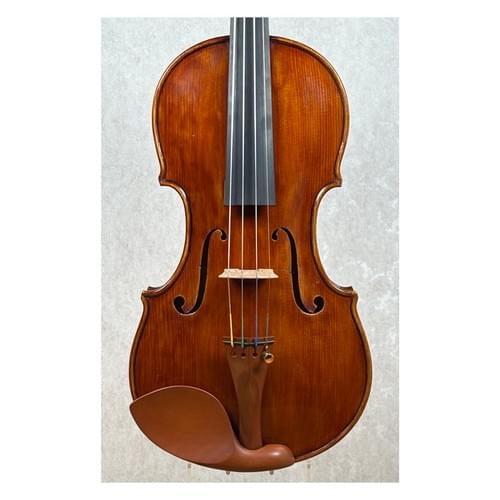
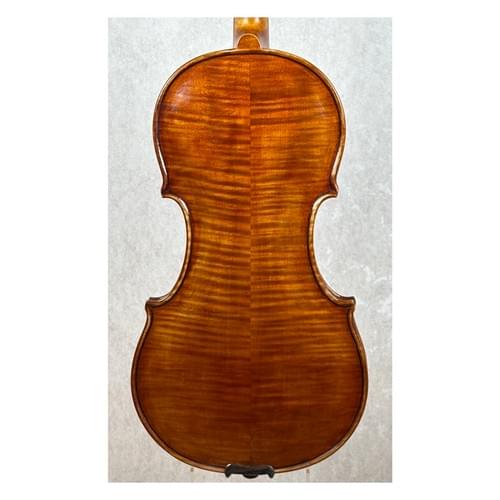
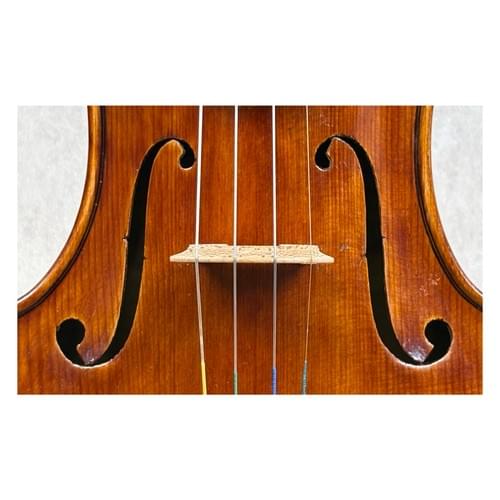
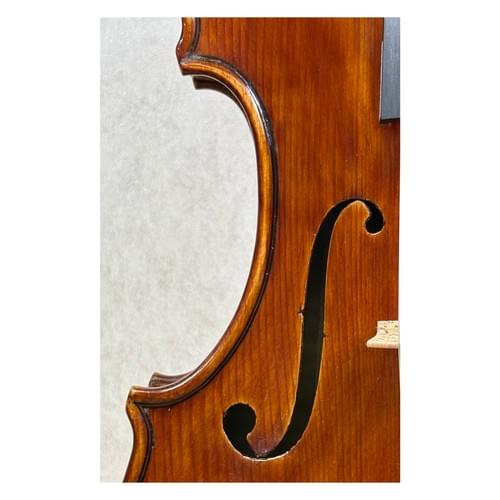
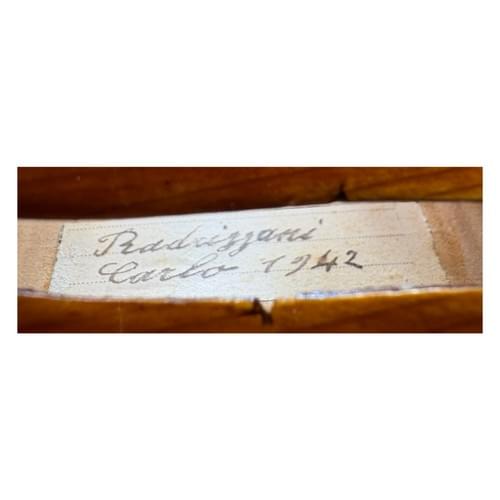
Violin, Carlo Radrizzani, 1942 Vevey (Switzerland)
Radrizzani家の製作を辿るうえで興味深いのが、近代ヴェネツィア派を築いたDegani家とのつながりです。AlessandroはヴェネツィアでEugenio Deganiに学んだことが記録され、AngeloについてもDeganiのもとで研鑽を積んだとされています。こうした北イタリアで培われた製作の伝統は、その後スイスへと移ったRadrizzani家の作品にも受け継がれていきました。
今回ご紹介するヴァイオリンは、1942年にCarlo Radrizzaniによって製作された一挺です。
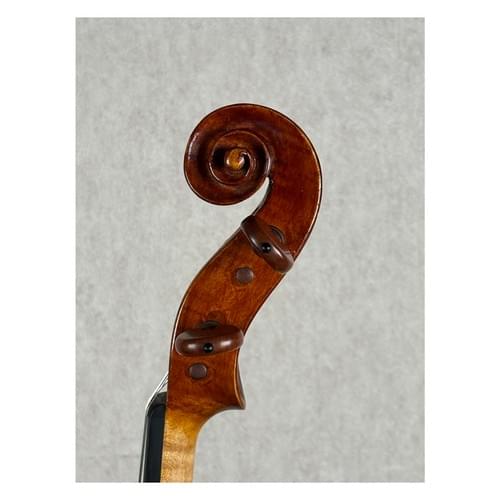
現在当工房にある1907年製Giulio Deganiのヴァイオリンと実際に比較すると、その歴史的なつながりを思わせる興味深い共通点を見ることができます。モデルの構成をはじめ、アーチングの考え方、エッジ周辺の造形、そしてスクロールの作りなど、随所にDeganiの製作を想起させる特徴が認められます。
もちろんCarloは単に先人のスタイルを模倣したのではなく、一族から受け継いだ製作伝統を自身の作品として発展させています。DeganiからRadrizzani家へとつながる製作の系譜と、イタリアの伝統がスイスへ渡り次世代へ受け継がれていく過程を、実際の楽器から感じ取ることのできる興味深い作品です。
Carlo Radrizzani (1896–1986) was a violin maker of Italian heritage who worked in Vevey, Switzerland. Born into a family of instrument makers, he learned the craft from his father, Angelo Radrizzani, and his uncle, Alessandro Radrizzani, continuing a family tradition deeply rooted in Italian violin making.
Of particular interest in understanding the Radrizzani tradition is the family’s connection with the Degani school of Venice. Alessandro is recorded as having studied with Eugenio Degani in Venice, while Angelo is also reported to have trained with Degani. This tradition, formed within the violin-making culture of northern Italy, was subsequently carried to Switzerland by the Radrizzani family.
The violin presented here was made by Carlo Radrizzani in 1942.
An especially interesting perspective is offered by comparing this instrument directly with a 1907 violin by Giulio Degani currently in our workshop. The two instruments reveal notable affinities in their overall model, approach to the arching, treatment of the edges, and aspects of the scroll, suggesting the continuation of a shared workshop tradition across generations.
Rather than simply reproducing the work of an earlier maker, however, Carlo developed the tradition inherited through his family into a style of his own. This violin offers a fascinating opportunity to observe how a tradition associated with the Degani school was transmitted through the Radrizzani family, carrying elements of Italian violin making into a new generation and a new setting in Switzerland.

